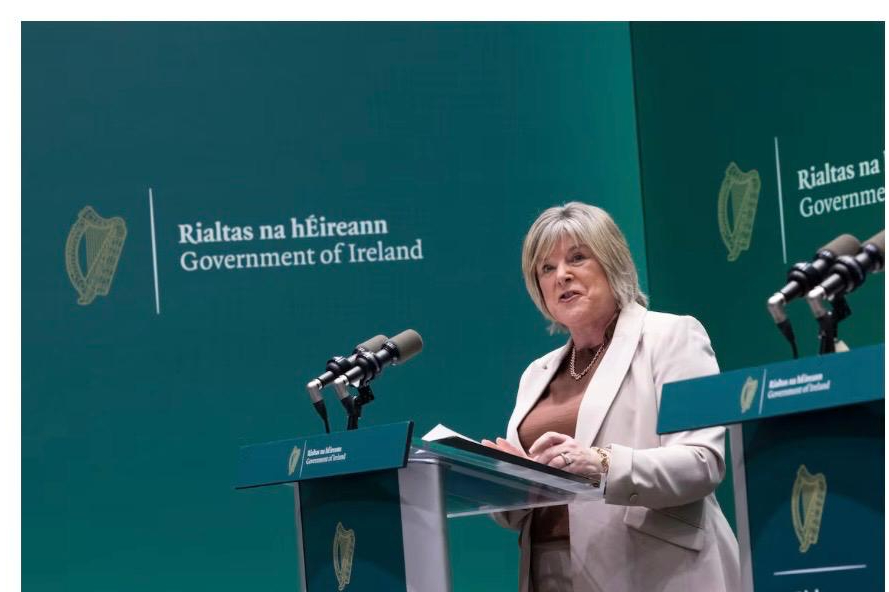
The announcement that the “Head of HSE gender healthcare is to step down at the end of the year, after drafting a “new model of care,” raises serious questions about the direction of those services in Ireland. (Mark Tighe, Irish Times, reported on this on Saturday 18/7/26)
At The Countess, we advocate for the rights and interests of women and children. We have consistently highlighted the risks of self-ID policies, the threat to single-sex spaces/services, the erosion of sex-based language in law and public policy, the dangers of gender ideology in healthcare, particularly for minors, and the push to embed gender ideology into the school curriculum at primary and post primary levels.
We note that “Minister of State Mary Butler praised the Icelandic model and sought funding for HSE gender clinic in Drogheda” as per letter released under FOI.
The “Icelandic Model” post 2019 Gender Autonomy Act, is an “informed consent model” based on gender self-ID. A 6-12 month initial assessment is undertaken to assess if the child has gender dysphoria. A positive diagnosis is required for the medical pathway. Social transition is fully supported. Puberty Blockers (PBs) can be prescribed at Tanner Stage 2 (onset of puberty) with “informed consent” of the child and parents/guardians. PBs are regarded as a reversible pause to puberty while the child considers their options (“time to think”). Cross-sex hormones can be prescribed at age 16. Surgery is only permitted after the age of 18.
- According to the latest figures from Registers Iceland/National Registry, exactly 200 children under 18 had changed their registered gender marker since the Gender Autonomy Act came into force at the beginning of 2020.
- This represents roughly 0.5% (1 in 200) of children aged 10+ in Iceland (population reference: ~39,823 in that group at that time.
Iceland boasts the highest per-capita rates for youth gender identification and legal transition among European countries. Medical transition rates appear elevated relative to population size, though precise numbers are not publicly available.
This approach differs from other Nordic countries like Sweden, Finland, and Norway who follow a more cautious approach, and who abandoned WPATH following revelations that the “standards of care” lacked any evidence for the benefits of extreme medical intervention, and because there was a disregard for medical ethics among practitioners.
Current overlaps between Ireland and Iceland
- Both jurisdictions have integrated gender ideology into schools via similar programmes like SPHE/RSE/Wellbeing & Anti-bullying.
- Gender self-ID has introduced a similar clash of rights, for example, conflicts over singe-sex spaces/sports/prisons/language etc.
- Free speech tensions and the chilling of gender critical voices from trans activists and NGOs.
- Ideological capture of state institution, including schools, healthcare providers, government departments and media.
Concerns about the Icelandic model and the possibility of its introduction into Ireland.
- The potential for social transition to fix a child into an identity they might grow out of. For the vast majority of children (85% approx) gender dysphoria will not persist beyond puberty, provided social transition has not occurred.
- Evidence has shown that Iceland has a higher than normal rate of youth transition than other Nordic countries (13 times that of Denmark)
- A surge in cases occurred in Iceland after the introduction of the Gender Autonomy Act 2019, and this raises concerns about social transition and the “informed consent model” of healthcare.
- After 2020, Iceland abandoned the gatekeeping/multidisciplinary assessment model and the diagnostic requirements for “gender identity disorder,” opting instead for the “informed consent model” which relies on patient consent with minimal barriers and weak evidence of the benefits/harms.
New Model of Care for Ireland?
Any new model of care in Ireland must be evidence-based, not based on ideology or on hard cases or personal preferences by politicians. The UK Cass Report found “remarkably weak” evidence for treatments such as puberty blockers. Cass also discouraged “social transition” as an active intervention that could lead vulnerable children down a lifelong medical pathway. Cass was very cautious about the use of cross-sex hormones, and surgery, especially for young people
Ireland must take note of these findings and proceed with caution. We need:
- A complete halt to medical transition for under 18s.
- No social transition for under 18s.
- Comprehensive exploratory mental health care that addresses underlying issues such as autism, trauma/other co-morbidities, same-sex attraction, and social contagion.
- Robust safeguarding that protects female-only spaces/sports/ services on the basis of biological sex.
- Open debate about the impacts of gender self-ID in Ireland, without the shaming of gender critical voices by ideologically captured lobby groups, politicians and media.
- Gender identity theory should not be introduced to pre-pubertal children and primary schools. Young children lack the cognitive maturity to grasp such concepts.
- Any discussion or teaching of gender identity theory to older children such as adolescents/secondary school students should focus on biological facts, should be delivered in a neutral manner, be evidence-based and involve parents at all stages.
- The HSE must treat all patients based on their biological sex and clinical need, not on the model of “informed consent” such as that currently in operation in Iceland.
We urge the HSE, the Dept of Health, and politicians, to engage with women’s groups like The Countess, and other organisations, to learn from international evidence, and to put safeguarding and reality first.
Women and children deserve privacy, dignity and safety, in healthcare and in every area of life.
The Countess